





- EDITIONS:
 Spanish News Today
 Alicante Today
 Andalucia Today

PROPERTY SEARCH

PROPERTY SEARCH
Today Earth is at its farthest point from the Sun. So why is Spain sweltering?
The planet reaches aphelion on Monday July 6, a cosmically counterintuitive moment that coincides with temperatures pushing well above 40°C across parts of the country
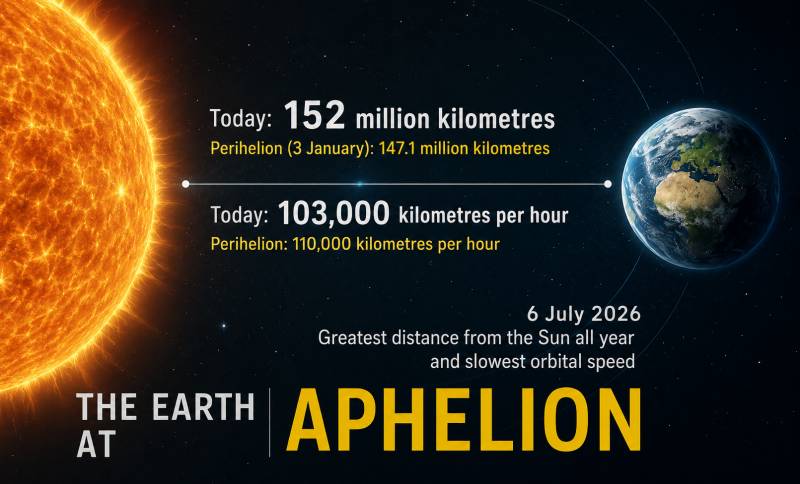 Here's a fact that sounds like it belongs in a pub quiz rather than real life. Today, Monday July 6, Earth is at aphelion, the point in its yearly orbit where it sits at the greatest possible distance from the Sun. That's around 152 million kilometres away, some 5 million kilometres further than we were back in January. And Spain is currently under an orange heat alert with temperatures forecast to exceed 40°C tomorrow. You couldn't make it up.
Aphelion comes from the ancient Greek: apo meaning far, and helios meaning the Sun. Its opposite, perihelion, is the point where Earth swings closest to our star, which happens, slightly bafflingly, in early January. So we're nearest the Sun in the depths of winter and furthest away in the height of summer. The universe has a sense of humour.
The reason none of this translates into cooler temperatures is that seasons have nothing to do with distance. It's all about tilt. Earth orbits at a 23.5 degree axial tilt, and right now the northern hemisphere is angled directly towards the Sun. That's what drives summer.
As Roy Spencer at NASA's Global Hydrology and Climate Center explains: "We're closer to the Sun in January, but the extra sunlight gets spread throughout the oceans." The average global temperature at aphelion is actually around 2.3°C higher than at perihelion, because more of Earth's landmass sits in the northern hemisphere and heats up faster. So being further away makes us hotter overall. Wonderful.
We have Johannes Kepler to thank for figuring out the elliptical orbit business back in 1609, when he proved the planets don't travel in perfect circles but in elongated ellipses, with the Sun at one focal point. The Catholic Church wasn't thrilled. One curious consequence of that elliptical path is that northern hemisphere summers last about five days longer than winters, because Earth moves fractionally slower when it's further from the Sun. Every cloud.
As for the heat itself, Spain is in the grip of a mass of very hot, dry air that isn't going anywhere quickly. Today brings a yellow warning with highs of 37°C, but Tuesday July 7 steps it up to orange, with inland areas expected to hit above 40°C in the shade at midday. Orange alert means serious potential impacts for vulnerable groups, so if you have elderly relatives or young children, keep a close eye on them, keep everyone hydrated, and save any outdoor exertion for the morning or evening.
The good news, if you can call it that, is that Earth won't always reach aphelion in summer. These dates drift by roughly one day every 58 years. By the year 6,430, perihelion will fall on the March equinox. Until then, the laws of orbital mechanics and the Spanish summer will continue to do exactly as they please.