





- EDITIONS:
 Spanish News Today
 Alicante Today
 Andalucia Today

PROPERTY SEARCH

PROPERTY SEARCH
Spanish astronomers discover new solar system with a potential 'habitable' planet
Researchers from Andalusia and the Canary Islands have helped confirm two planets orbiting a red dwarf star far beyond our solar system
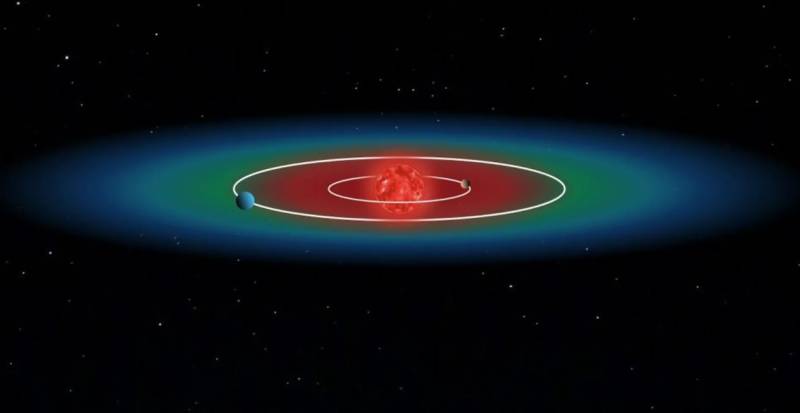
Artistic representation of the TOI-1752 planetary system and its two exoplanets provided by IAA-CSIC
Spanish astronomers have helped confirm a fascinating new planetary system more than 300 light-years from Earth, including one world that could be hot enough to have a surface of molten rock and another that may have the right conditions for liquid water.
The system, known as TOI-1752, is around 337 light-years away and was first spotted by NASA’s TESS space telescope, which searches for planets by looking for tiny dips in the brightness of stars as planets pass in front of them.
A team led by Spain’s Institute of Astrophysics of Andalucia (IAA-CSIC) has now confirmed that the two objects spotted by TESS really are planets. Researchers combined observations from space with data collected by telescopes on Earth to rule out other possible explanations for the signals.
Spain played an important part in the work, with the Institute of Astrophysics of Andalucia carrying out the analysis and interpretation of the data. Researchers from the Institute of Astrophysics of the Canary Islands also contributed observations from the Teide Observatory in Tenerife.
The two planets couldn’t be much more different.
The closer planet, TOI-1752 b, whizzes around its star in less than a day. Because it’s so close to its red dwarf star, it receives enormous amounts of radiation and could be hot enough for rock to melt on the side facing the star. Scientists believe this could even produce what’s known as a secondary atmosphere, created by material released from the planet’s surface.
Further out is TOI-1752 c, the planet that has really caught the attention of researchers. It’s roughly twice the size of Earth and sits in what astronomers call the optimistic habitable zone.
That doesn’t mean scientists have found another Earth or evidence of life. The habitable zone simply refers to the region around a star where temperatures could potentially allow liquid water to exist on a planet’s surface if the right atmospheric conditions are present.
Even so, TOI-1752 c could become an interesting target for future research. Its characteristics are similar to another exoplanet that scientists are already studying closely to learn more about planetary atmospheres.
Observations from the Teide Observatory were particularly useful, with the MuSCAT2 instrument allowing researchers to watch the planets pass in front of their star in different wavelengths of light.
So while neither of these distant worlds is likely to be the next destination for a Spanish holiday, they are giving scientists plenty to investigate right here on Earth.
Image: IAA-CSIC