





- EDITIONS:
 Spanish News Today
 Alicante Today
 Andalucia Today

PROPERTY SEARCH

PROPERTY SEARCH


Spanish telescope discovers new comet after more than 40 years
Calar Alto’s veteran Schmidt telescope spots rare celestial object during test observations
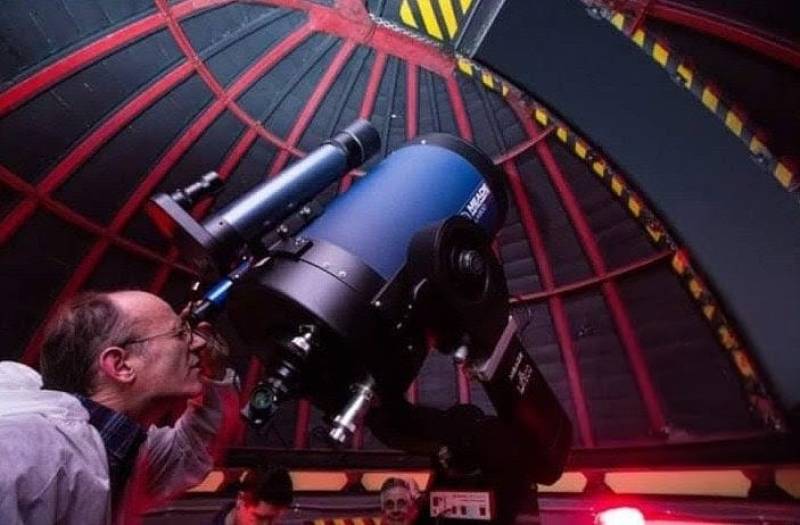 A Spanish observatory has detected its first new comet in over four decades, in what astronomers are calling a “remarkable and unexpected” find.
The discovery was made by Rainer Kresken, an engineer with the European Space Agency (ESA), who identified the new comet, officially named P/2025 W3 (Kresken), while running technical tests with a newly installed camera at the Calar Alto Astronomical Observatory in Almería. Working remotely from the German city of Darmstadt, Kresken spotted a faint, elongated object while testing the observatory’s historic 80-centimetre Schmidt telescope.
“The discovery was made on the same night as the tests with a new CMOS camera,” Kresken said. “This camera, along with the excellent telescope, allows astronomers to detect and observe very faint objects like this comet.”
The telescope was aimed at a section of the sky in the constellation Gemini, near the twin stars Castor and Pollux, when the unusual object first appeared in images taken on Friday November 28 2025. Follow-up observations over the following nights showed that the object had shifted slightly across the sky, but its long, thin tail remained visible - a clear sign that it was comet-like in nature.
This marks only the second comet to be discovered with the same telescope since Comet Thiele (C/1985 T1) was spotted in 1985, and the third connected to the instrument overall, after Comet Kohoutek in the 1970s when the telescope was based in Hamburg.
Scientists believe P/2025 W3 (Kresken) could be an active main-belt asteroid: a hybrid object that behaves like a comet but orbits among the rocky asteroids between Mars and Jupiter. It travels around the Sun once every four years, coming as close as 300 million kilometres to our star.
According to Kresken, “it will take some time to determine the mechanism responsible for its activation.” Researchers note that such objects are of huge scientific interest because they may hold clues about the origins of water and organic compounds on Earth.
The telescope’s operators say the find highlights the value of modernising older equipment. After more than 50 years of service, the Schmidt telescope’s recent camera upgrade has ensured it continues to contribute to European research into near-Earth objects and space safety.
This latest discovery not only adds a new comet to astronomical records but also reaffirms Spain’s key role in European space observation and planetary monitoring.
You might also be interested in: Spain prepares for once-in-a-lifetime trio of eclipses
Image: wikicommons