





- EDITIONS:
 Spanish News Today
 Alicante Today
 Andalucia Today

PROPERTY SEARCH

PROPERTY SEARCH
Space fans in Spain may be able to spot a giant asteroid passing Earth on Saturday
The space rock will come within 2.56 million kilometres of Earth and should be visible from Spain with binoculars or a small telescope

If you fancy a spot of stargazing this weekend you could be in for a treat, as a large asteroid is set to make a close pass by Earth on Saturday June 27.
According to the European Space Agency (ESA), the asteroid, known as 1997 NC1, was first discovered almost 30 years ago and measures somewhere between several hundred metres and more than 1.5 kilometres across, making it a sizeable object by any asteroid standards.
Before anyone starts worrying, scientists have stressed that there is no danger whatsoever. ESA has confirmed that the probability of the asteroid colliding with Earth is zero and that its flyby is completely safe.
At its closest point, the asteroid will pass around 2.56 million kilometres from our planet. That might sound close in astronomical terms, but it’s still about 6.6 times farther away than the distance between Earth and the Moon.
The closest approach is expected at 1.14pm Central European Time on Saturday, when the asteroid will be travelling at around 8.9 kilometres per second.
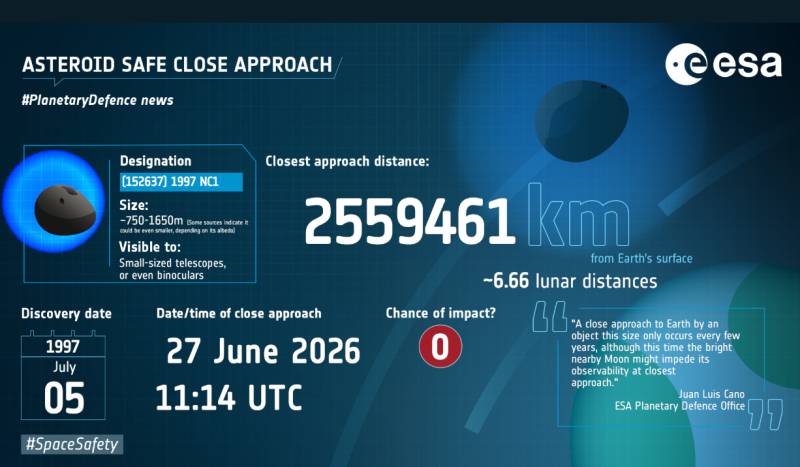
The good news for astronomy enthusiasts is that 1997 NC1 should be visible using a small telescope or even a pair of powerful binoculars. Viewing conditions are expected to be best in areas with clear skies across the Northern Hemisphere, including Spain.
However, ESA has pointed out that the brightness of the Moon could make the asteroid harder to spot for some observers; the full ‘Strawberry Moon’ is set to appear just a couple of days later on June 30.
Although headlines about asteroids often raise concerns, experts say impacts involving large objects are extremely rare. Monitoring near-Earth asteroids remains an important part of planetary defence efforts, but in this case there is no cause for alarm.
Instead, Saturday's flyby offers a rare opportunity to catch a glimpse of one of the Solar System's wandering space rocks as it passes safely by our planet.
Images: Freepik / ESA