





- EDITIONS:
 Spanish News Today
 Alicante Today
 Andalucia Today

PROPERTY SEARCH

January 2026 was the gloomiest Spain has seen in 30 years
Last month was also the wettest in Spain in a quarter of a century
January always feels like it drags on forever after Christmas, but this year seemed particularly grim thanks to the relentless bad weather that battered Spain throughout the month.
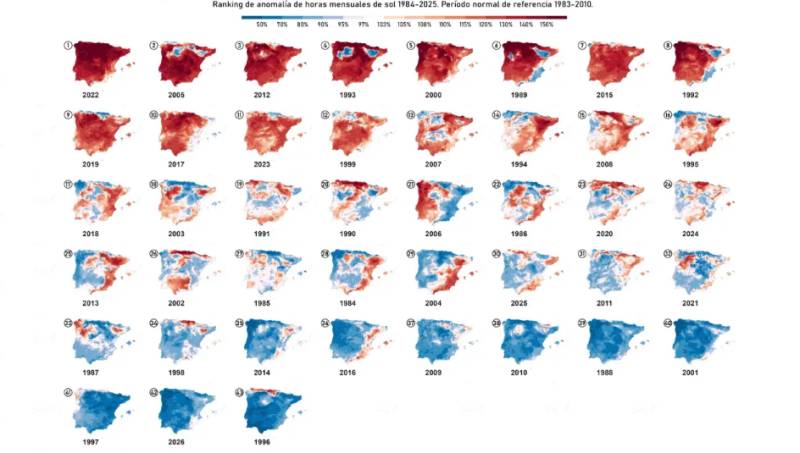
The succession of storms that pounded the country last month, and which shows no sign of letting up, darkened the days across the entire country. Spain has just experienced its January with the fewest hours of sunshine since 1996 and the second darkest in the series that began in 1984.
This January was also the wettest in the last quarter of a century, with 85% more rain than the 1991-2020 average. Moreover, it was the seventh dampest January on record since 1961, and the second wettest of the 21st century, surpassed only by 2001.
The figures come from researcher Dominic Royé at the Biological Mission of Galicia, who prepared a graph based on European satellite data from Eumestat.
Royé explained that January was the month with the greatest negative anomaly in sunshine hours in the entire record, with an average of 29 fewer hours across Spain. Only 1996 was worse, with 33 fewer hours than usual.
The country normally gets around 185 hours of sunshine in January, although there are significant differences between areas. The north usually sees between 100 and 120 hours, while the south gets between 250 and 270 hours.
This year, almost the entire country fell below these averages, with the exception of Murcia, Almería and the Balearic Islands, which stayed within normal ranges. The Atlantic coast and the northwest corner saw the biggest drops.
Galician cities registered very high percentage falls. In Santiago de Compostela, sunshine hours compared to the average for this time of year were slashed by almost 50%, in Vigo by 48% and in A Coruña by 46%. Even more significant decreases occurred in Ourense (57%), Pontevedra (56%) and Lugo (55%).
These figures are much higher than those of other Spanish cities mentioned by the researcher, such as Madrid (20%), Sevilla (30%), Gijón (40%) and Burgos (40%).
Geography plays a role as well. The greatest reductions in sunshine tend to occur in mountainous areas because of the topography, and the impact on the coast is usually less because cloud cover clears more quickly.
Cloud cover is the factor that causes the reduction in sunshine hours, although Royé explains that the amount of rain doesn't necessarily mean less sun. The sky can be cloudy without rain, just as there can be heavy downpours in a short period, like summer storms, followed by clearing. The season and day length also matter, as days are shorter in January than in July.
The reduction in daylight hours has well-known effects on people's moods, pointed out Royé, who researches the relationship between health and climate.
"It has a physiological effect but also a psychological one, because it often depresses us, especially those of us who live further north," he said.
The latest storm to batter Spain was Marta, the 13th high-impact storm of the season. Aemet explained that this is the earliest year the letter M has been reached. Until now the earliest was Myriam, named on March 3, 2020.
For more weather news go to our Weather & Climate page or follow the Spain Weather Watch Facebook group for regular updates
Image: Dominic Royé