



- EDITIONS:
 Spanish News Today
 Alicante Today
 Andalucia Today
PROPERTY SEARCH

PROPERTY SEARCH
Exploring Águilas’ western coastline beneath El Peñón del Roncaor
A gradual, accessible dive revealing pipelines, rock formations and rich marine life just off Playa de la Colonia
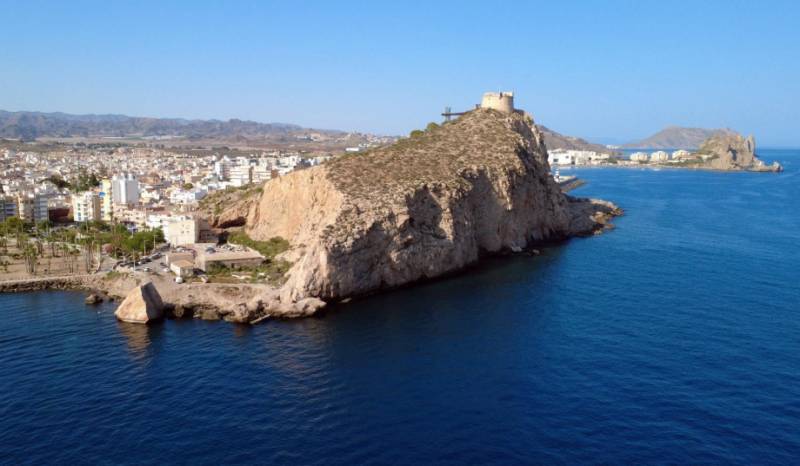
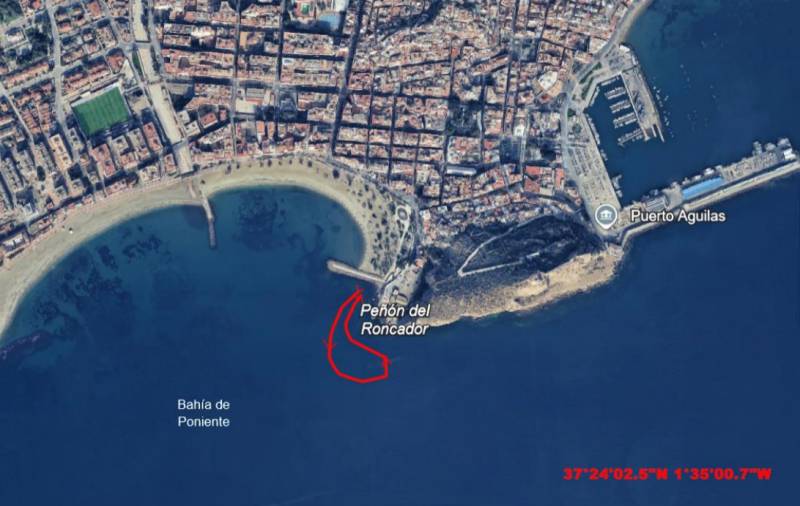
On the western side of the headland that leads up to the Castillo de San Juan de las Águilas, Playa de la Colonia marks the starting point for one of the more unusual and quietly rewarding dive sites in Águilas.
Just offshore, a striking rock formation known as El Peñón del Roncaor rises above the coastline, and it is here that the dive begins.
The entry point sits beside a breakwater, where the seabed immediately reveals a line of large stones extending outwards. These were originally placed to protect the initial section of a major pipeline connected to the desalination plant, and they now form the first part of a route that blends natural habitat with industrial structure.
 From the start, the dive is calm and accessible. The depth increases gradually, with the stone line guiding the route as it moves away from shore. These rocks are heavily colonised by marine growth and create a network of cracks and sheltered spaces where small species thrive.
Damselfish are one of the most common sights here, gathering in large, active shoals. Their appearance changes noticeably with age, with juveniles showing a vivid electric blue colour that fades into darker brown tones as they mature. Alongside them, schools of salema porgy move through the area, particularly where patches of Posidonia oceanica and Cymodocea nodosa seagrass spread across the seabed.
As the dive continues, the stone formation eventually turns at a right angle, changing direction and extending along a 120-degree heading. Beyond this point, the rocks give way to the exposed desalination pipeline itself, a substantial structure around two metres in diameter.
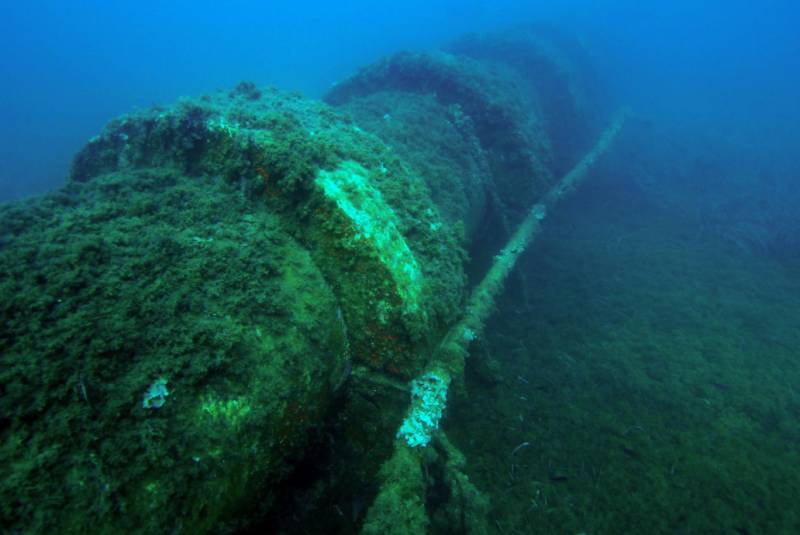 The pipe is supported above the seabed by large metal clamps that join its sections together at around 10 metres depth. Over time, these artificial surfaces have become fully integrated into the marine environment, now covered in algae, sponges and other encrusting life that provide both food and shelter for a wide range of species.
Nudibranchs are frequently seen here, their bright colours standing out against the muted tones of the pipe and surrounding rock. These shell-less sea slugs are particularly well adapted to this type of environment, feeding on the organisms that grow across the structure.
Fish life is varied and plentiful throughout the dive. False pollack are commonly encountered, moving in and out of the shadows, while the occasional small grouper can also appear around the rockier sections. In the deeper, sandier areas where parts of the pipe sit closer to the seabed and light is reduced, more secretive species such as scorpionfish and rockfish may be hiding in plain sight.
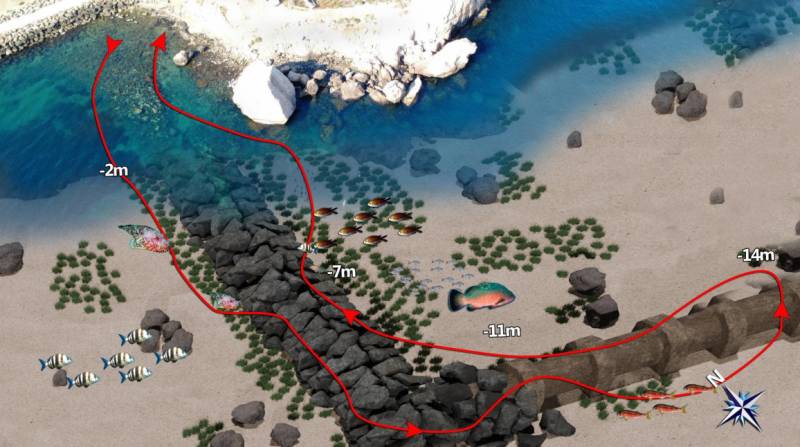 At its furthest point, the dive can reach depths of over 15 metres before the return route begins. Navigation is straightforward, simply following the line of the pipe back towards the stone formation and gradually retracing the path to shore.
El Peñón del Roncaor offers a simple but varied dive where natural seabed, coastal engineering and marine life come together in one continuous route. It’s an easy site to follow, but one that rewards attention to detail, with small moments of marine activity unfolding at every turn.
More information about Águilas including beaches, what to see, what's on and tourist information can be found on ÁGUILAS TODAY.